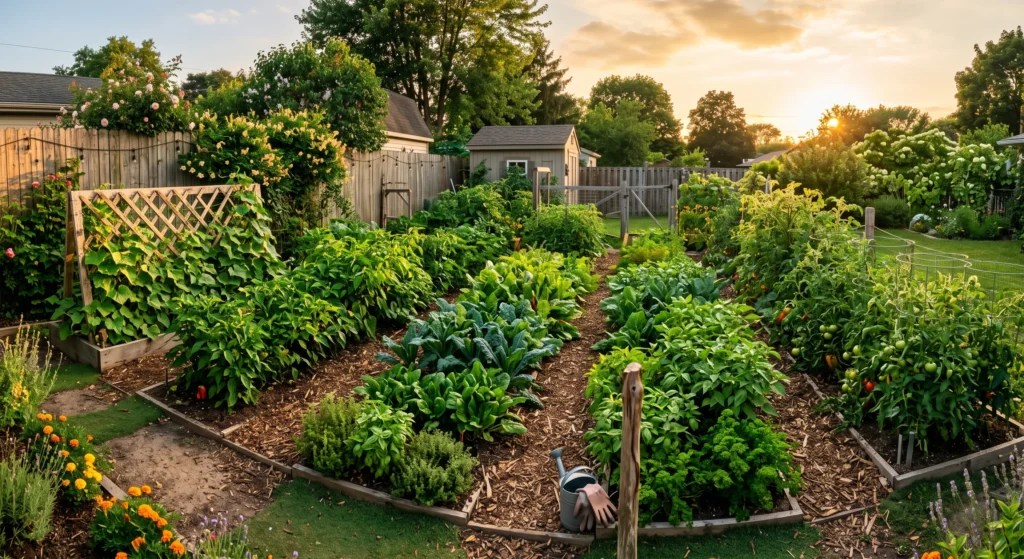
You’ve watered on schedule, picked out disease-resistant varieties, and given your plants the right amount of sun. Yet something still isn’t working. Leaves look pale, growth stalls halfway through the season, or water just sits on top of the ground instead of soaking in. Nine times out of ten, the problem isn’t the plants at all. It’s what’s underneath them.
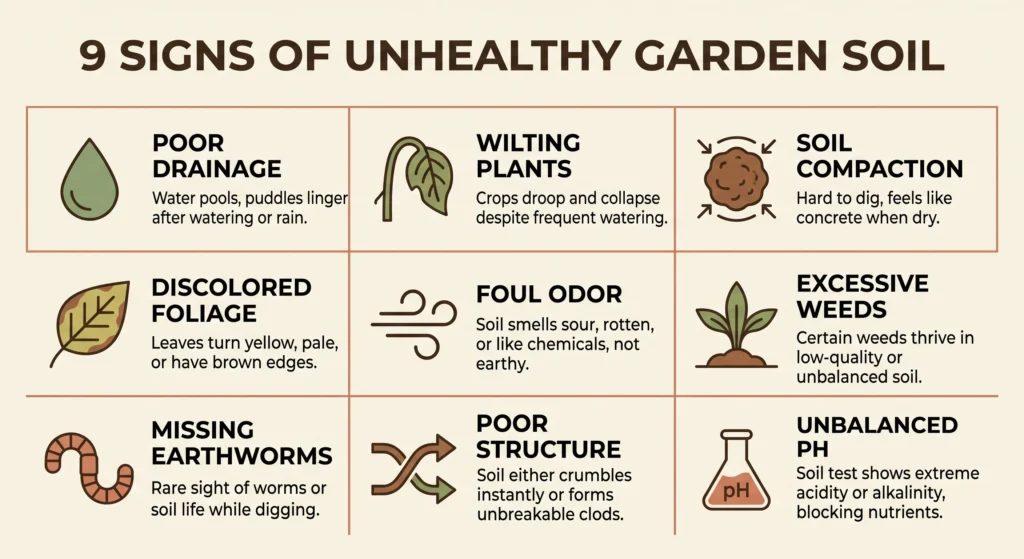
Soil doesn’t announce its problems the way a wilting plant does, but it leaves clues everywhere if you know where to look. This guide walks through the real, observable signs that your garden soil needs work, why each one happens, and what actually fixes it.
Why Soil Health Gets Overlooked
Most gardening advice focuses on the visible half of the plant. Prune here, fertilize there, watch for pests. Soil sits quietly underground doing the heavy lifting, and it rarely gets blamed until every other fix has failed.
The irony is that soil problems are usually easier to diagnose and cheaper to correct than pest infestations or disease outbreaks. You just have to know what you’re seeing.
1. Water Pools on the Surface Instead of Draining
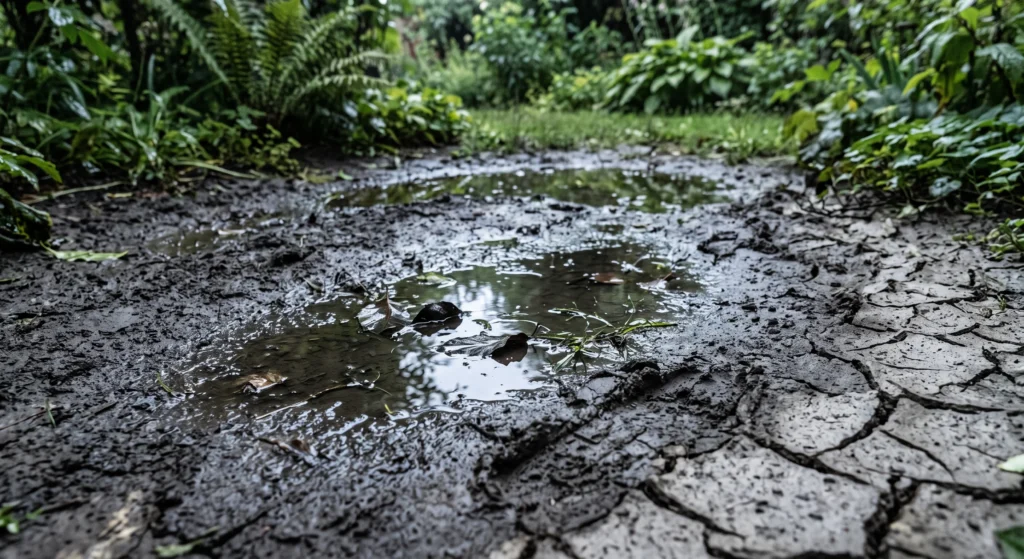
Stand in your garden right after a rainstorm or a deep watering session. If puddles form and take a long time to disappear, or if water runs off to the side rather than soaking in, your soil has a structure problem.
This usually points to compaction or a heavy clay content. Compacted soil has had its air pockets squeezed out, often from repeated foot traffic, heavy equipment, or simply years of rain hammering down on bare ground. Without those pockets, water has nowhere to go.
Clay-heavy soil behaves similarly but for a different reason. The particles are so fine and tightly packed that water molecules struggle to move between them. You’ll often notice the ground cracking into hard plates when it dries out, almost like a dry lakebed.
What helps: Working in organic matter such as compost or aged manure breaks up dense soil and creates the gaps water needs to travel through. Avoid walking on garden beds when the soil is wet, since that’s when compaction happens fastest. For badly compacted areas, a broadfork or garden fork worked gently through the top several inches can open things up without disturbing soil layers too much.
2. Plants Wilt Even When You’ve Watered Recently
If your plants droop within a day or two of a good soaking, the soil may be draining too fast rather than too slow. Sandy soil is the usual suspect here. It has large particles with big gaps between them, so water runs straight through before roots get a real chance to absorb it.
This is the opposite problem from waterlogging, but it comes from the same root cause: poor soil structure that can’t hold onto moisture and nutrients the way a healthy soil profile should.
What helps: Organic matter again does most of the work, but in this case it acts like a sponge rather than a drainage aid. Compost, shredded leaves, and coconut coir all help sandy soil retain water longer. Mulching the surface also slows evaporation and gives roots more time to take up what they need.
3. The Soil Is Rock Hard or Crumbles to Dust
Pick up a handful of soil from your garden bed. Good soil should hold its shape loosely when squeezed and break apart with gentle pressure, similar to a slightly damp chocolate cake crumb. If it forms a hard, sticky ball that won’t break apart, you’re dealing with too much clay and not enough organic content. If it falls apart into fine dust immediately, you likely have sandy or depleted soil lacking structure.
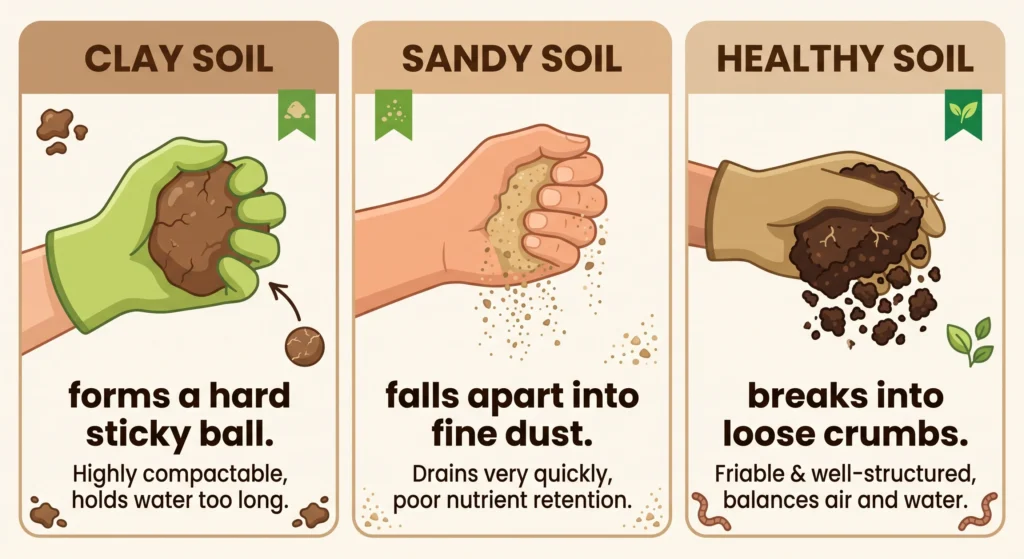
Gardeners sometimes call this the “squeeze test,” and it remains one of the simplest ways to judge soil texture without sending a sample anywhere.
“Feed the soil, not the plant” is an old piece of farming wisdom, and it holds up because healthy soil structure feeds itself through the organic matter cycle, rather than needing constant outside correction.
4. Plants Show Nutrient Deficiency Symptoms
Yellowing between leaf veins, stunted growth, purple-tinged leaves, or leaf edges that brown and curl are all classic signs of nutrient shortages. While these symptoms can sometimes point to disease or pest damage, they’re just as often a sign that the soil itself has been depleted of what plants need to thrive.
Continuous planting in the same bed without replenishing nutrients will eventually strip the soil of nitrogen, phosphorus, potassium, and trace minerals like iron and magnesium. Vegetable gardens are particularly prone to this since crops are harvested and removed rather than left to decompose back into the ground.
A few common patterns worth knowing:
- Yellowing older leaves first often signals a nitrogen shortage, since nitrogen moves from older growth to newer growth when supplies run low.
- Purple or reddish leaf undersides can indicate a phosphorus deficiency, especially in cooler soil.
- Yellowing leaf edges with green veins frequently points to a potassium or magnesium shortfall.
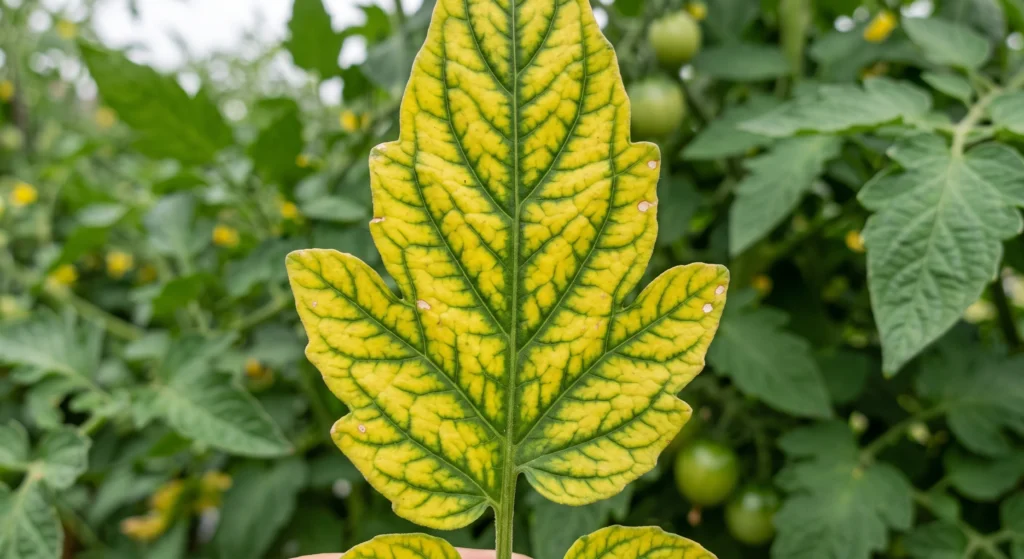
What helps: A soil test through your local extension office will tell you exactly what’s missing rather than leaving you guessing. From there, targeted amendments (rather than generic all-purpose fertilizer) address the actual gap. Crop rotation and cover cropping also help prevent the same nutrients from being pulled out season after season.
5. Your Soil Smells Off or Looks Discolored
Healthy soil has an earthy, faintly sweet smell, largely thanks to a compound called geosmin produced by soil bacteria. If your soil smells sour, like rotten eggs, or simply has no smell at all, something is wrong.
A sulfur or rotten smell usually means the soil is waterlogged and has gone anaerobic, meaning oxygen can’t reach the microbial life that keeps soil healthy. Soil with no smell at all often indicates it’s biologically dead, lacking the microorganisms that break down organic matter and cycle nutrients.
Color matters too. Rich, dark soil generally has good organic content. Pale, grayish, or yellowish soil often lacks organic matter and the microbial activity that comes with it.
What helps: Improving drainage addresses the anaerobic smell issue directly. For biologically inactive soil, adding finished compost introduces the bacteria, fungi, and other organisms needed to restart the nutrient cycle. Avoid over-tilling, which can destroy the fungal networks that take years to establish.
6. Weeds Are Telling You Something
Weeds aren’t just an annoyance. Certain species are strong indicators of specific soil conditions, and paying attention to what’s growing uninvited can save you a soil test.
- Plantain and knotweed tend to show up in compacted soil, since they’re built to survive where roots struggle to penetrate.
- Dandelions and chicory often signal compacted, low-calcium soil, using their deep taproots to break through where other plants can’t.
- Clover frequently appears where nitrogen is low, since clover fixes its own nitrogen from the air and thrives where other plants are starved of it.
- Horsetail and rushes point toward poor drainage and consistently wet conditions.
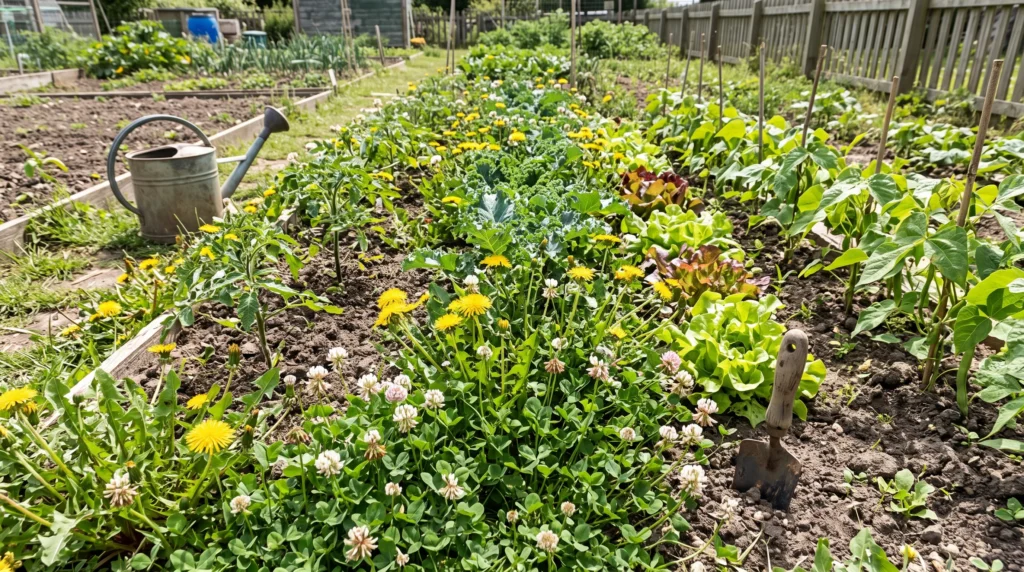
None of these are absolute proof on their own, but a pattern of the same weeds returning year after year is worth paying attention to.
7. Earthworms Are Scarce or Absent
Dig a small hole, about a foot deep, in your garden bed on a mild day and count how many earthworms you find. Healthy garden soil typically supports a noticeable worm population. If you’re coming up empty, that’s a red flag.
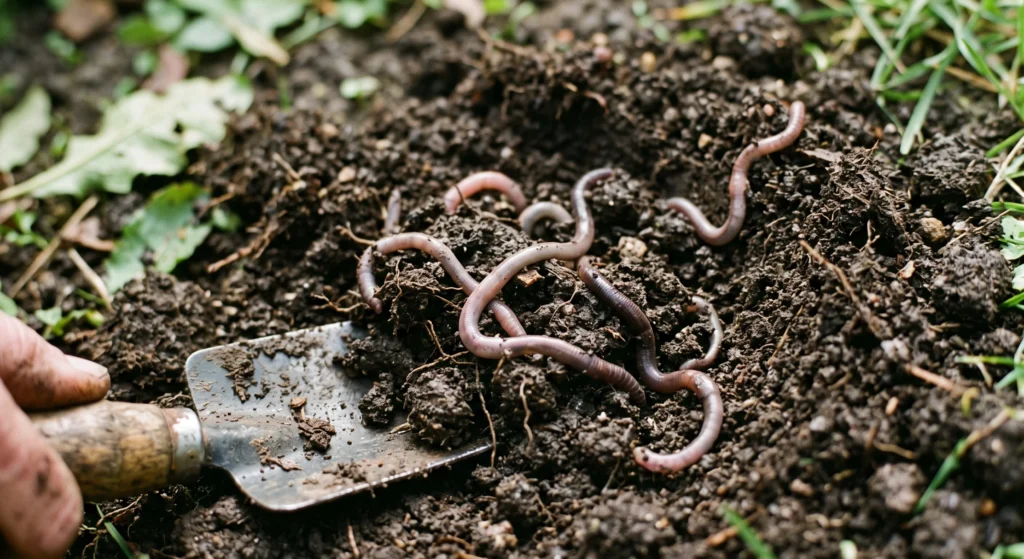
Earthworms need organic matter to eat and enough moisture and oxygen to survive. Their absence usually means the soil is too compacted, too dry, too acidic, or simply lacking the organic material they feed on. Since earthworms also aerate soil and leave behind nutrient-rich castings as they move, their absence tends to make existing problems worse over time.
What helps: Adding compost gives worms both food and habitat. Reducing tilling helps preserve worm populations, since heavy tilling disturbs their burrows and can kill them outright. Keeping soil consistently moist, without waterlogging it, also supports their return.
8. Growth Is Uneven Across the Same Bed
If some plants in a row thrive while others just a few feet away struggle despite identical care, soil consistency is likely the culprit. Garden beds often have hidden variation from old construction debris, buried rock, previous land use, or simply how compost and amendments were mixed in unevenly during setup.
This kind of patchiness is easy to miss because gardeners tend to assume uniform care means uniform results. Testing soil at multiple spots in the same bed, rather than just once, often reveals surprising differences in pH or texture within a few feet of each other.
9. The Soil pH Is Out of Range
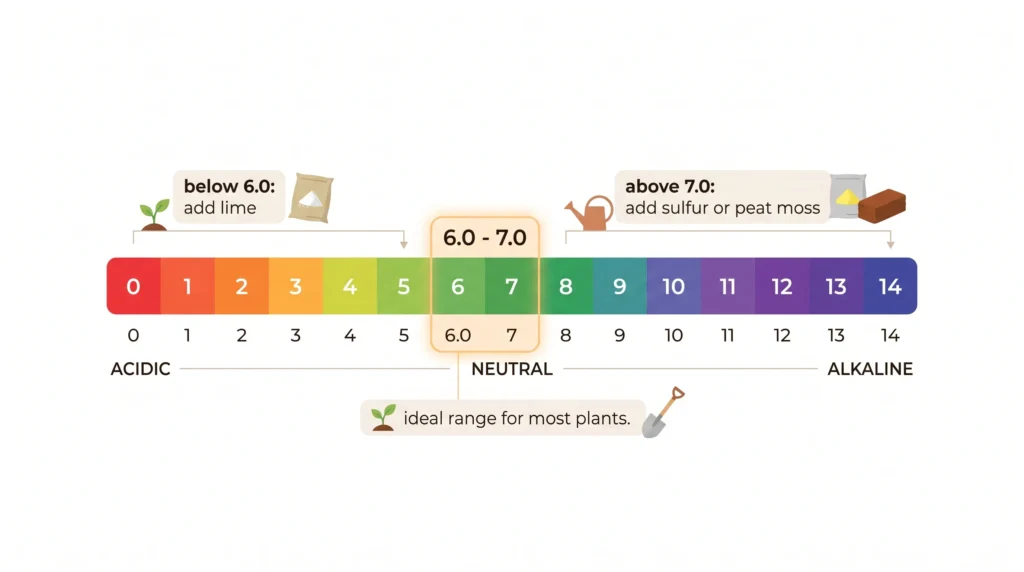
Most vegetables and ornamentals prefer a slightly acidic to neutral pH, generally in the 6.0 to 7.0 range, though specific plants vary. When pH drifts too far outside what a plant needs, it can’t absorb nutrients properly even if those nutrients are physically present in the soil.
Signs of pH imbalance often mimic nutrient deficiency, which is part of why so many gardeners add fertilizer when the actual problem is that existing nutrients are locked up and unavailable at the current pH level.
What helps: A simple pH test kit, available at most garden centers, gives you a starting point. Lime raises pH in overly acidic soil, while sulfur or peat moss can lower pH in alkaline soil. Adjustments should be gradual, since swinging pH too quickly can shock soil biology.
Getting a Proper Soil Test
Visual signs point you in the right direction, but a lab or extension office soil test gives you actual numbers for pH, nutrient levels, and organic matter percentage. Many university extension programs offer this service for a modest fee, and the results usually come with specific amendment recommendations based on what you’re growing.
Testing every two to three years, or whenever you notice persistent problems, keeps you working with facts rather than guesswork.
Building Better Soil Over Time
Soil improvement isn’t a single fix. It’s an ongoing practice that compounds season after season. Composting kitchen scraps and yard waste, rotating crops, planting cover crops during off seasons, and minimizing how much you disturb the soil structure all add up over a few years into noticeably richer, more productive ground.
Gardeners who’ve worked the same plot for a decade or more often say the biggest improvements came gradually, not from one dramatic overhaul. A bed that struggled to grow anything worthwhile can turn into some of the most productive ground on the property, simply through consistent, unglamorous soil care.
Pay attention to what your soil is telling you through drainage, smell, texture, and the plants (and weeds) growing in it. The fixes are rarely complicated. They just require noticing the problem before it shows up as a dead plant.